The 2026 Hyundai Palisade Recall: What Every Parent Needs to Know About the Power Seat Danger
This recall involves a child fatality. A stop-sale order has been issued for all 2026 Hyundai Palisades.
On March 7, 2026, a child in Ohio was killed when a power-folding second-row seat in a 2026 Hyundai Palisade failed to detect them in its path. The seat continued to fold without stopping, trapping the child. It is the kind of news that stops every parent mid-scroll, and we want to talk about it openly and honestly so you have the facts you need to protect your family.
Hyundai has since issued a stop-sale order on all 2026 Palisades and is working to deploy a software update that addresses the defect. This is one of the most significant child safety recalls we have covered, and whether you own a Palisade or not, there are important takeaways here for every parent who drives a vehicle with power-adjustable seats. Let's walk through everything together.
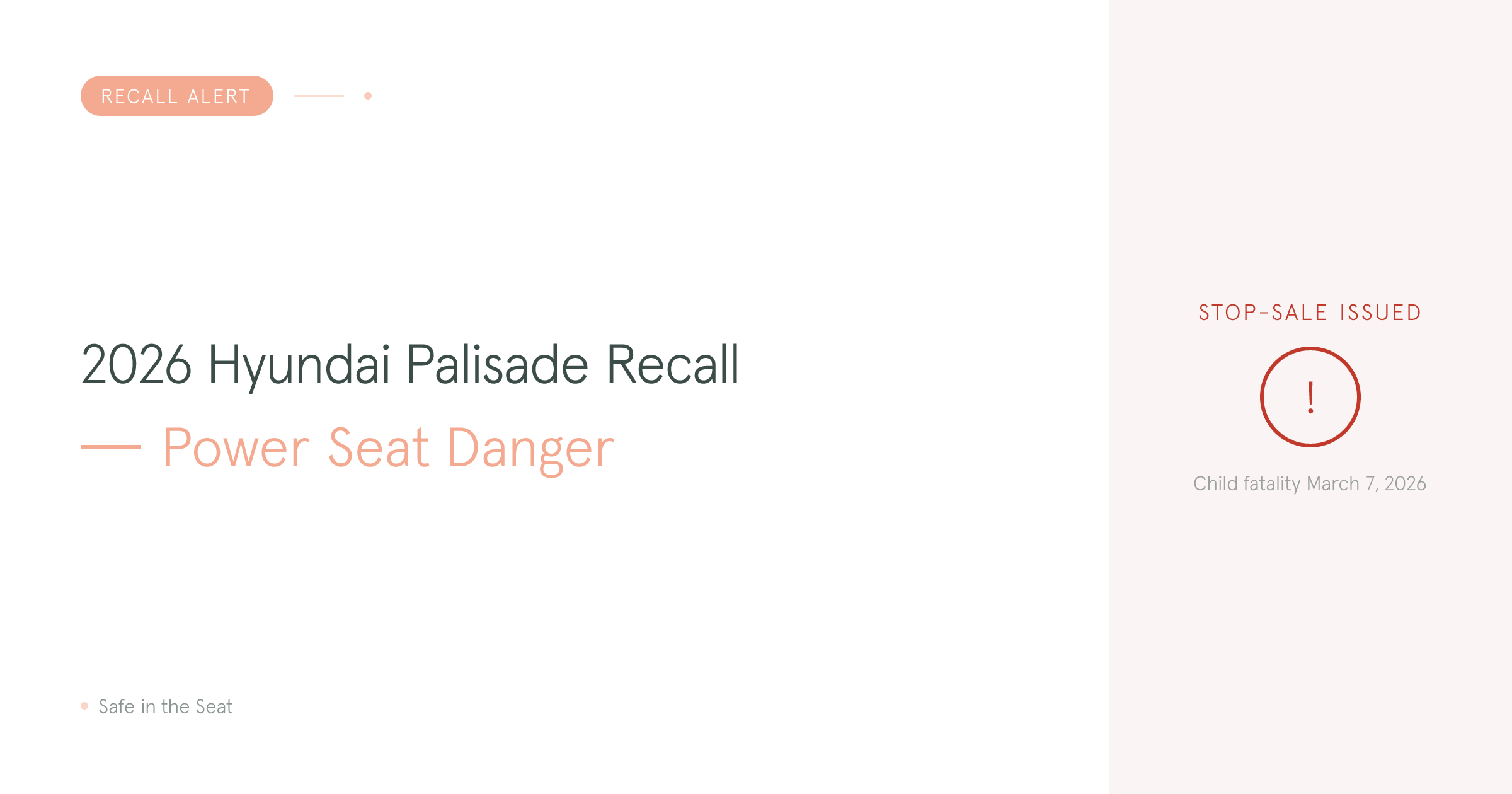
The 2026 Palisade recall involves a fatal power seat defect.
What Happened
On the evening of March 7, a young child was near the second-row seat of a parked 2026 Hyundai Palisade when the power-folding mechanism was activated. The seat's built-in obstruction sensors, which are designed to stop the seat from moving when something is in its path, failed to detect the child. The seat continued folding forward, creating a crush and entrapment situation that proved fatal.
The family called emergency services immediately, but the child could not be saved. In the days that followed, NHTSA opened an investigation and Hyundai moved quickly to halt sales of the vehicle. Our hearts go out to this family, and we share this information not to frighten you but to make sure every parent understands the risk so no other family experiences this tragedy.
It is worth saying plainly: this was not a case of misuse or negligence. This was a mechanical and software failure in a vehicle safety system. The sensors that were supposed to protect a child did not work as designed.
Which Vehicles Are Affected
Key Facts
- Vehicle: 2026 Hyundai Palisade
- Affected trims: All trims equipped with power-folding second-row seats
- Status: Stop-sale order issued — dealers cannot sell new or used units until the fix is applied
- NHTSA Campaign Number: 26V-198
- Estimated vehicles affected: All 2026 model-year Palisades produced to date
If you currently own or lease a 2026 Hyundai Palisade, your vehicle is part of this recall. There is no subset of trims or production dates that are excluded. Hyundai has cast a wide net here, and that is the right call given the severity of the defect.
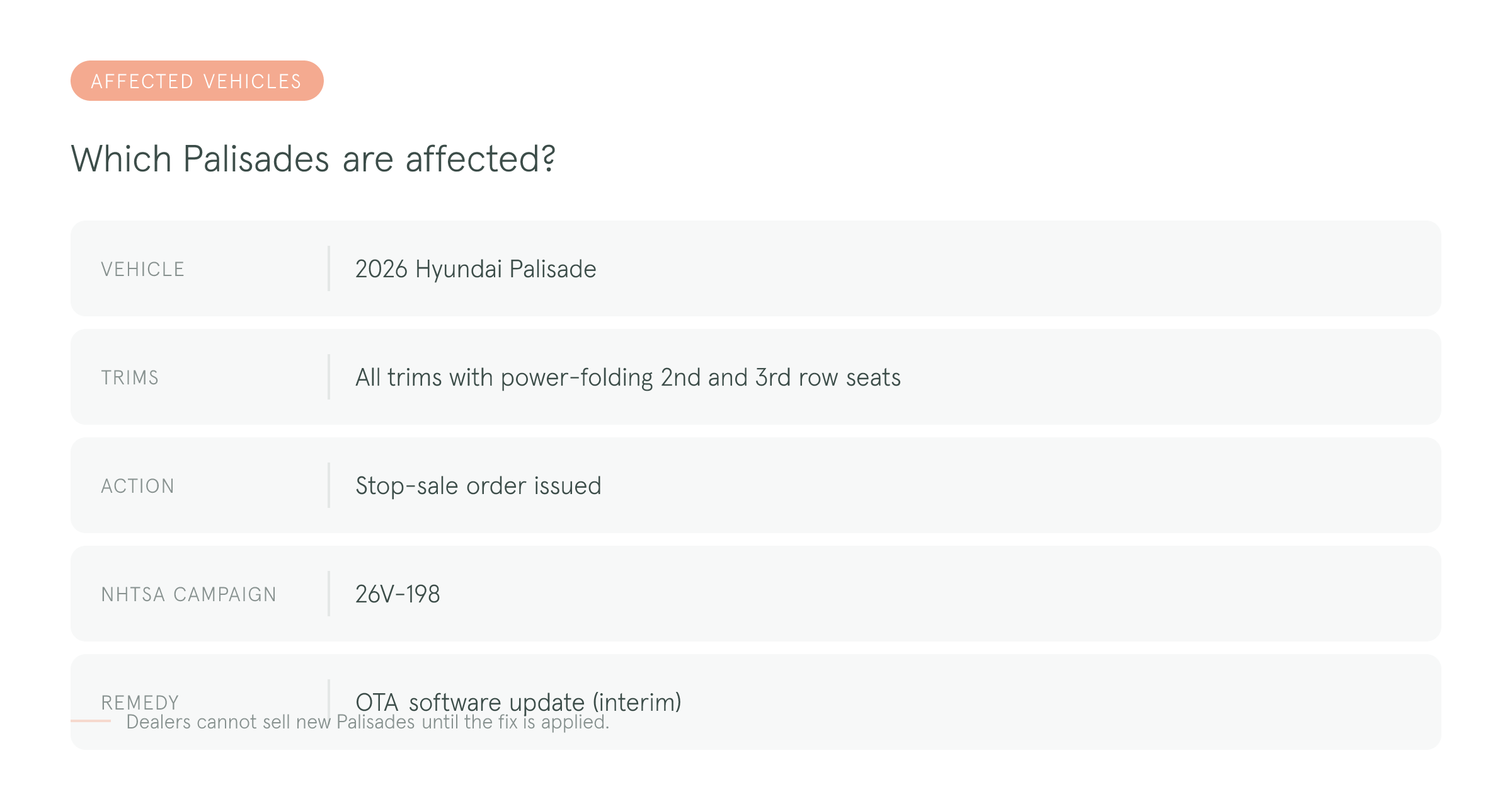
Every 2026 Palisade with power-folding second-row seats is included in this recall.
What the Defect Actually Is
Here is what you need to understand in plain terms: the second-row seats in the 2026 Palisade can fold forward at the push of a button to give passengers easier access to the third row. This is a convenience feature that many families love, especially when you are loading kids and gear into the back of a three-row SUV.
Built into that folding mechanism are sensors that are supposed to detect when something, or someone, is in the way. When the sensors work correctly, the seat stops moving and reverses direction. In the affected vehicles, those sensors can fail to register an obstruction. The seat keeps folding forward with significant force, creating a crush zone between the folding seat and the console or floor in front of it.
For a small child, that space becomes an entrapment hazard. Children are naturally curious, and it takes only a moment for a toddler or young child to move into a position where the folding seat could pin them. The force of the motor is more than enough to cause serious injury or death, which is exactly what happened in Ohio.
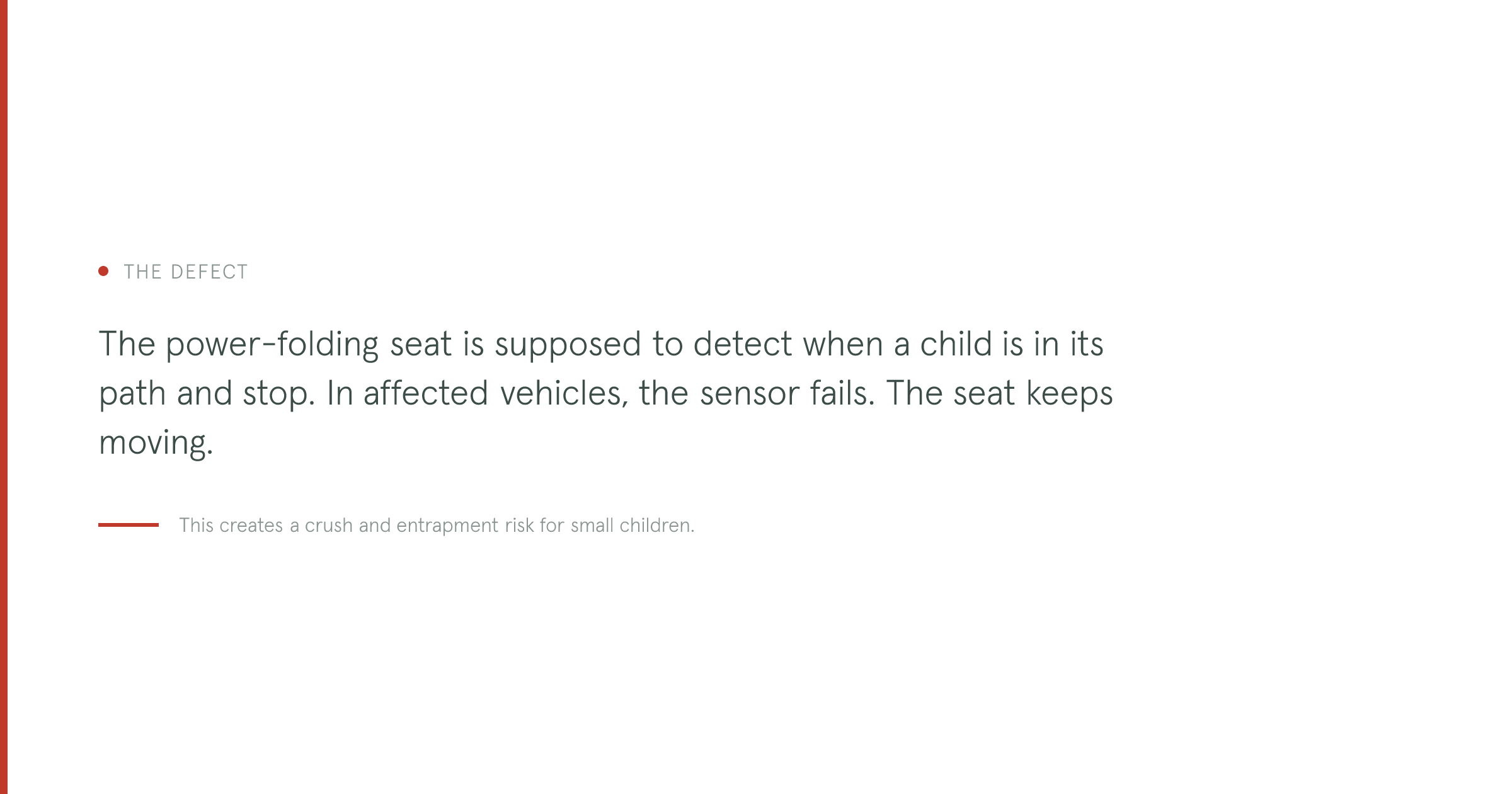
The obstruction sensors in the power-folding mechanism can fail to detect a child in the seat's path.
What Hyundai Is Doing
Hyundai has taken several steps since the incident. First, they issued a stop-sale order, which means dealerships are not allowed to sell any new or used 2026 Palisade until the fix has been applied. This is a significant move that signals how seriously Hyundai is treating this defect.
The planned remedy is an over-the-air (OTA) software update that recalibrates the obstruction detection sensors and adds a secondary safety check to the folding mechanism. Hyundai has stated that the update will also reduce the force applied by the motor during the fold cycle. For owners who cannot receive the OTA update, dealers will perform the update in person at no cost.
As of this writing, Hyundai has not published a firm timeline for when the update will be available. We will update this post as soon as that information is released. In the meantime, the steps below will help you keep your family safe.
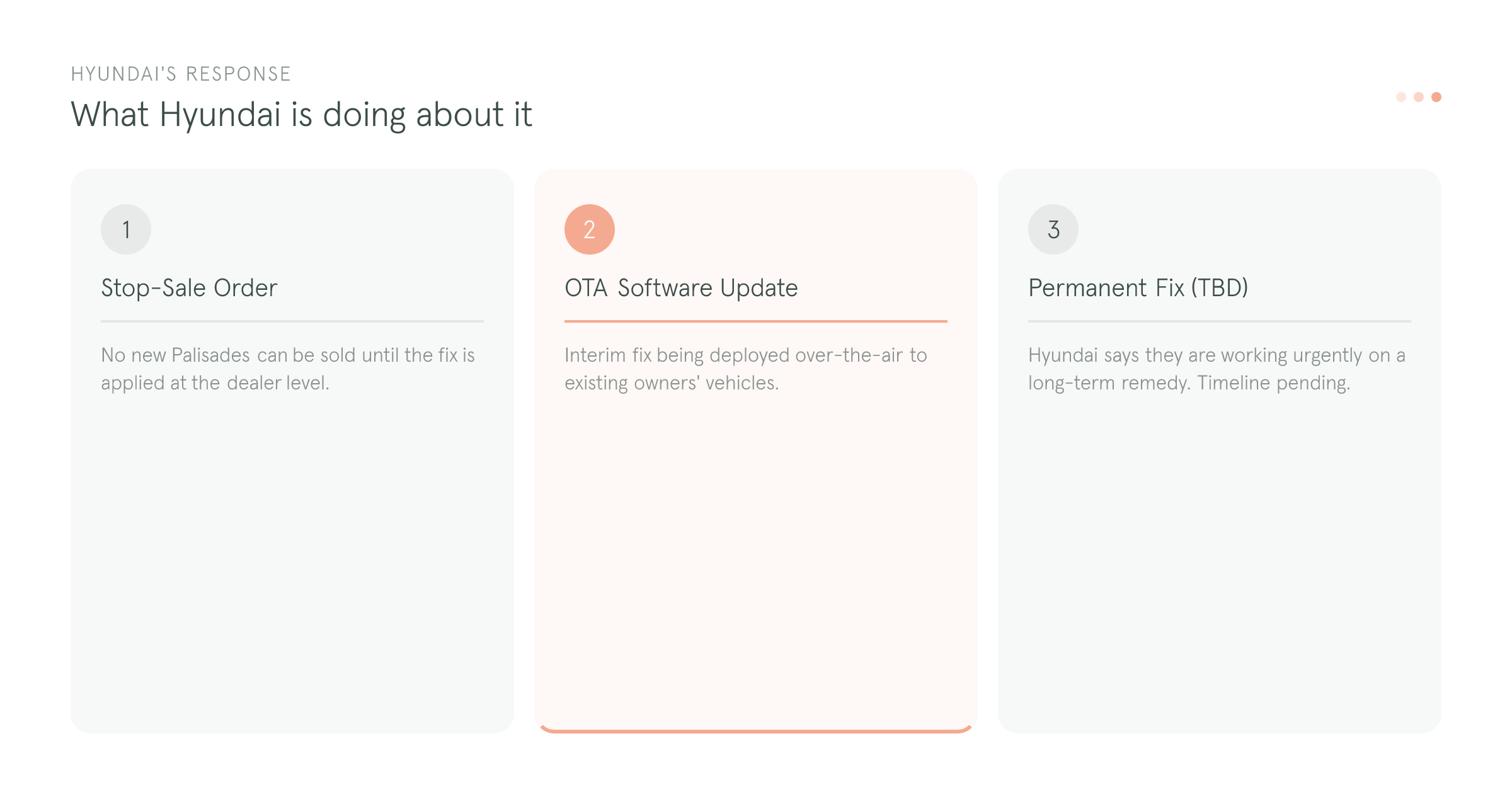
Hyundai is deploying a software update and has halted all sales until the fix is ready.
What to Do Right Now
If you own a 2026 Hyundai Palisade, take these five steps today:
- Check your VIN at nhtsa.gov/recalls to confirm your vehicle is part of the recall.
- Keep children away from seat controls. Do not allow kids to play near or operate the power-folding seat buttons, even supervised.
- Disable the power-fold feature if your vehicle allows it. Check your owner's manual or ask your dealer how to lock out the second-row fold function.
- Contact your Hyundai dealer to register for the recall repair and ask to be notified the moment the software update is available.
- Schedule the fix as soon as it is available. Do not wait. This is a stop-everything, get-it-done-today kind of recall.
We know that disabling a feature you use every day is inconvenient, especially when you are wrangling kids in and out of a three-row SUV. But until the software update is applied, the manual workaround is the safest path. Fold the seats by hand using the manual release lever if you need third-row access.
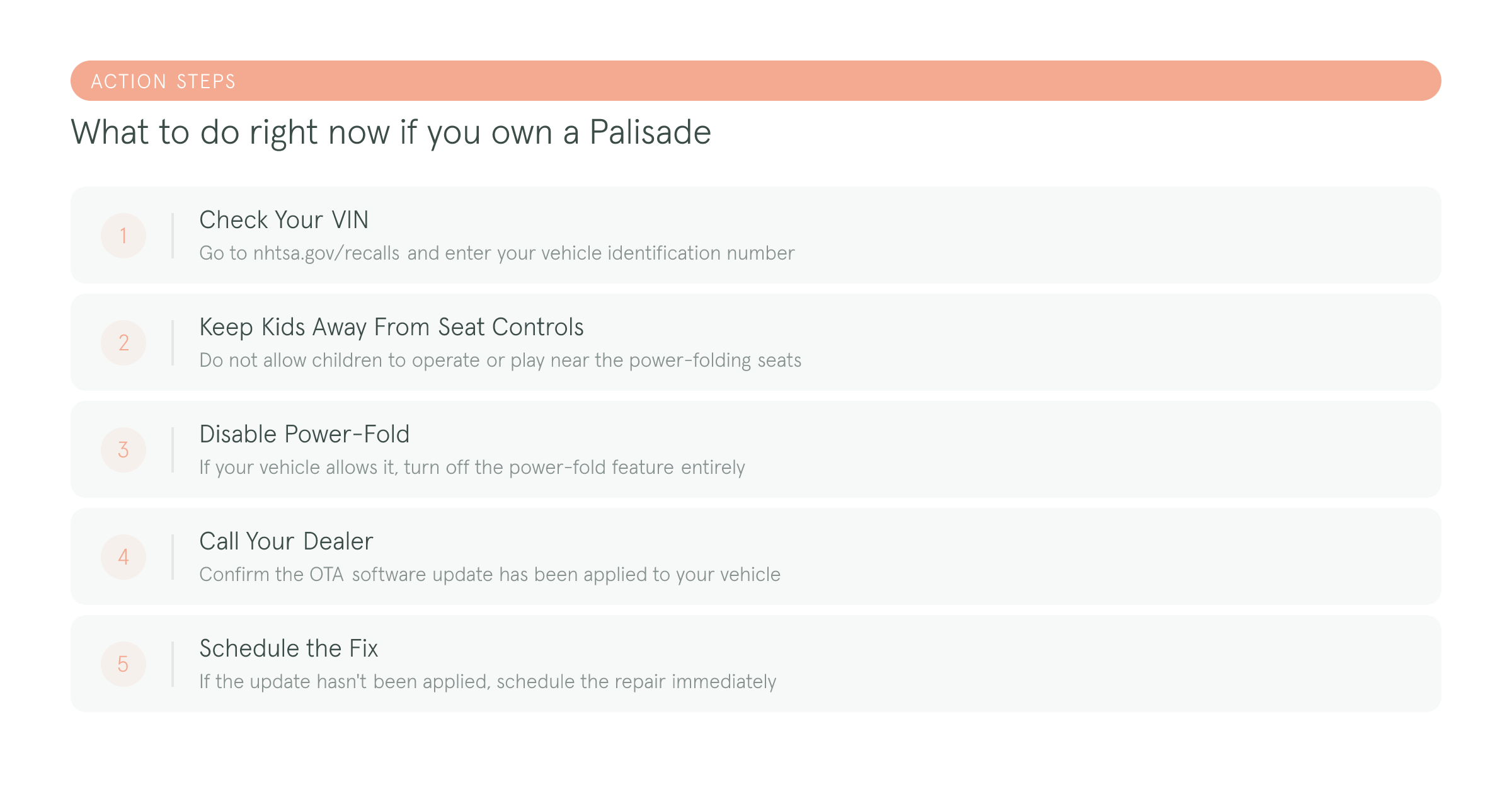
Five steps to take today if you own an affected Palisade.
The Bigger Picture — Power Seats and Child Safety
As car seat safety educators, we spend most of our time talking about the car seat itself: the harness, the installation, the angle, the fit. But this recall is a stark reminder that the vehicle seat underneath your child's car seat matters too. Most parents have never thought about the vehicle seat as a hazard, and before power-folding and power-reclining seats became standard, it really was not one. That has changed.
Power-folding and power-reclining seats are increasingly common in the SUVs and minivans that families drive every day. The Palisade, Telluride, Highlander, Pilot, and nearly every minivan on the market now offer some form of powered seat adjustment. These features make life easier, but they also introduce moving parts with real force into the space where your children sit, climb, and play.
No matter what vehicle you drive, here are habits worth building right now. Teach your children that seat buttons are not toys and are never to be pressed without a grown-up. Always visually check the area around power seats before pressing any controls. And know that many power seat features remain active even when the vehicle is off, which means the risk exists in your garage and your driveway, not just on the road.
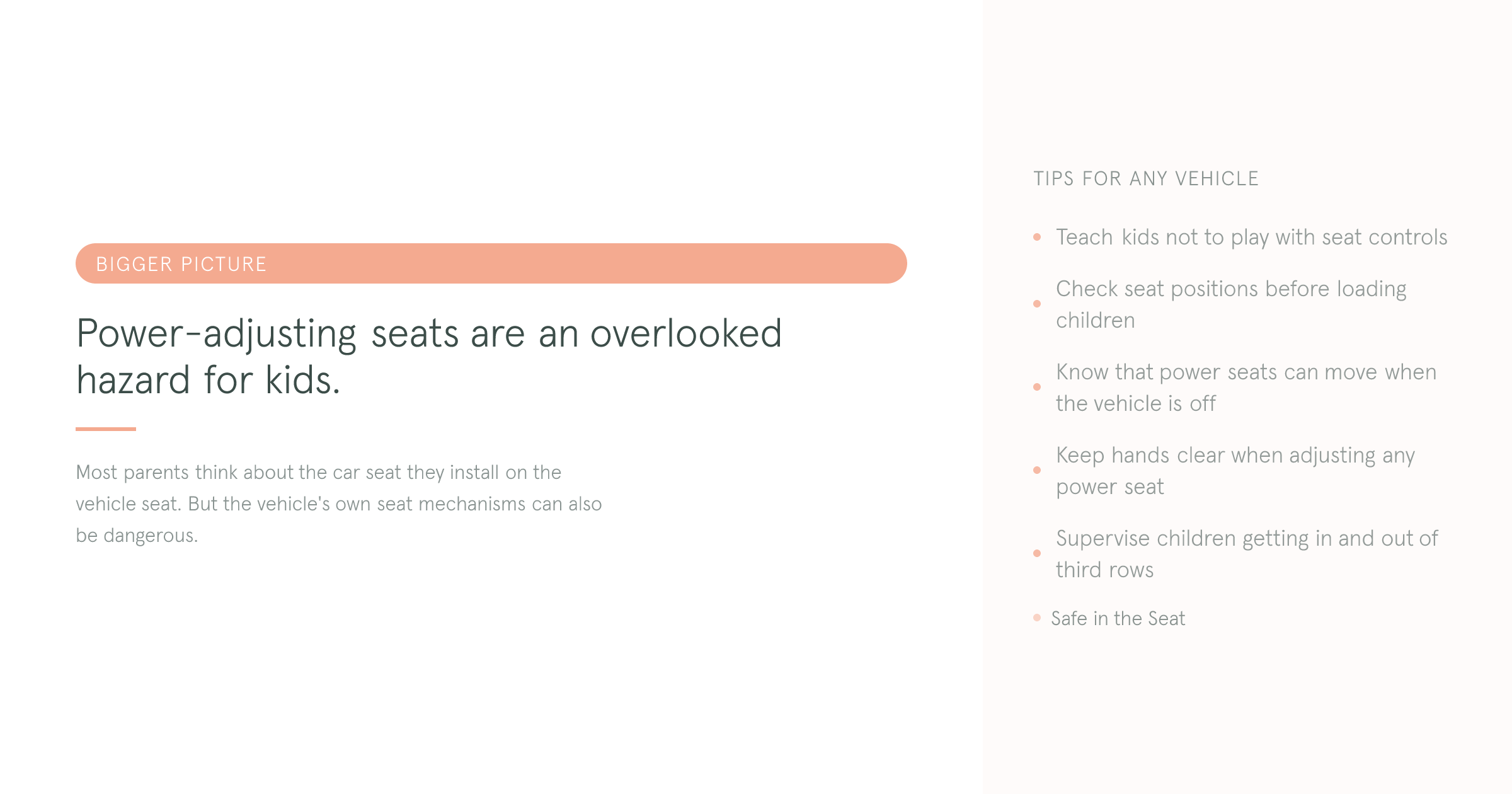
Power seats are in almost every family SUV and minivan now. Build safe habits around them.
How to Check for Recalls on Any Vehicle
If this recall has you wondering whether your own vehicle has any open recalls, checking is fast and free. Go to nhtsa.gov/recalls and enter your 17-digit Vehicle Identification Number (VIN). You will find your VIN on your registration card, your insurance documents, or on a small plate visible through the bottom-left corner of your windshield. NHTSA will show you every open recall associated with your specific vehicle.
You can also use checktoprotect.org, a tool from the National Safety Council that makes the process even simpler. We recommend checking your VIN at least twice a year, or any time you hear about a major recall in the news. It takes less than two minutes and it is one of the easiest things you can do to keep your family safer on the road.
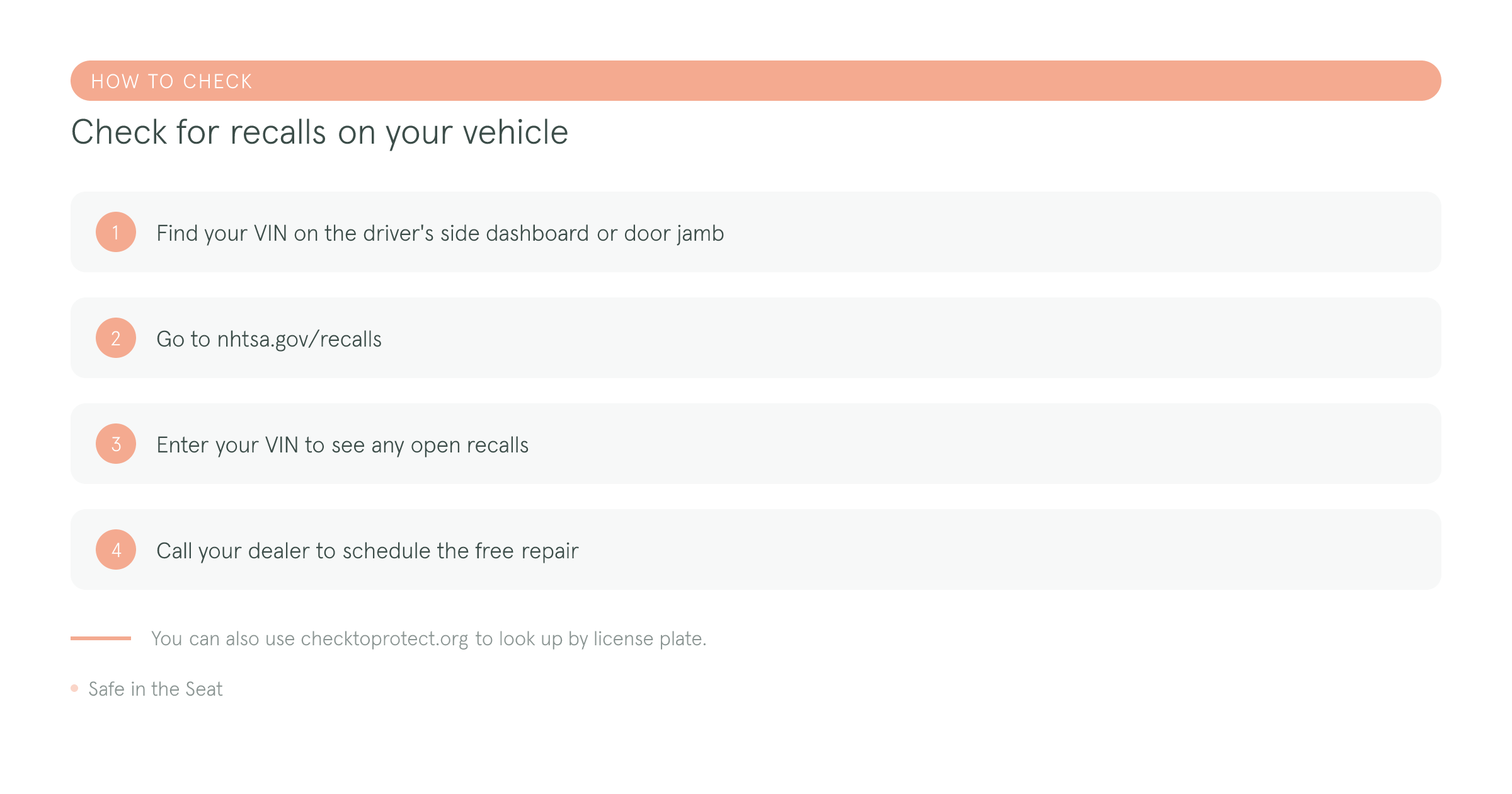
Checking for open recalls on your vehicle takes less than two minutes at nhtsa.gov/recalls.
The bottom line: if you own a 2026 Palisade, act now. If you don't, build safe habits around power seats.
Need More Help?
If you have questions about how a recall impacts your car seat setup, email us at hello@safeintheseat.com. Our certified CPSTs are here to help.
Get 1:1 HelpSources
- NHTSA Recall Campaign 26V-198 — 2026 Hyundai Palisade Power Seat Defect
- CBS News — "Hyundai Issues Stop-Sale Order for 2026 Palisade After Child Fatality" (March 2026)
- Consumer Affairs — "March 2026 Auto Recall Roundup: Hyundai, Toyota, Ford, Kia"
- Hyundai USA — Official Recall Notice for 2026 Palisade Owners
- NHTSA — "How to Use the NHTSA Recall Lookup Tool" (nhtsa.gov/recalls)